Real Materials
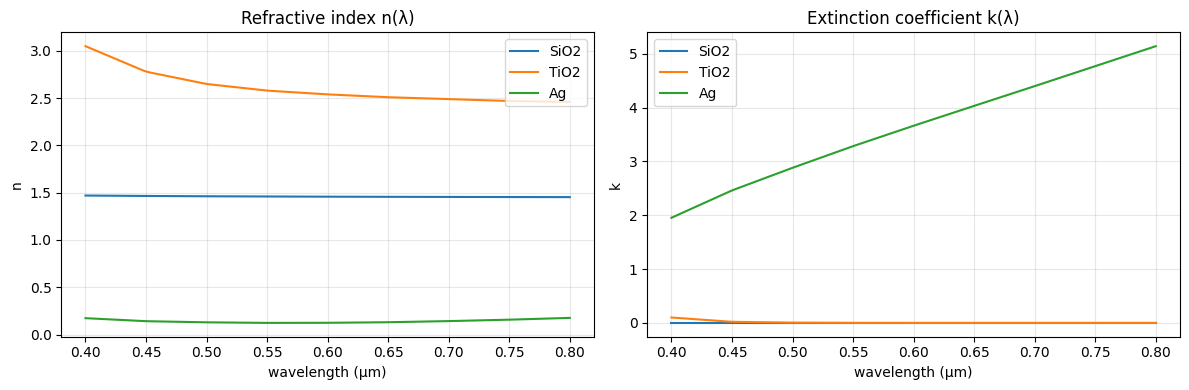
Use wavelength-dependent refractive indices from DiffTMM's bundled catalogs
instead of constant numbers. The Material class supplies
dispersive n(λ) and absorptive k(λ) data, looked up by name and passed
directly to any solver.
Notebook: 3_real_materials.ipynb
Inspect a material's dispersion
Material(name).ior(wvln) returns the complex refractive index at the given
wavelengths (μm) — real part n, imaginary part k:
import torch
from difftmm import IsotropicFilmSolver, Material, list_materials

device = torch.device("cuda" if torch.cuda.is_available() else "cpu")
print(len(list_materials()), "known materials")

wvln = torch.linspace(0.40, 0.80, 100, device=device)
for name in ["SiO2", "TiO2", "Ag"]:
    n = Material(name, device=device).ior(wvln)   # complex tensor
    print(name, "n@550nm =", n[27].real.item(), "k@550nm =", n[27].imag.item())
SiO₂ is a low-loss dielectric, TiO₂ a high-index dielectric, and Ag a metal
with a large imaginary index in the visible.
Anti-reflection coating
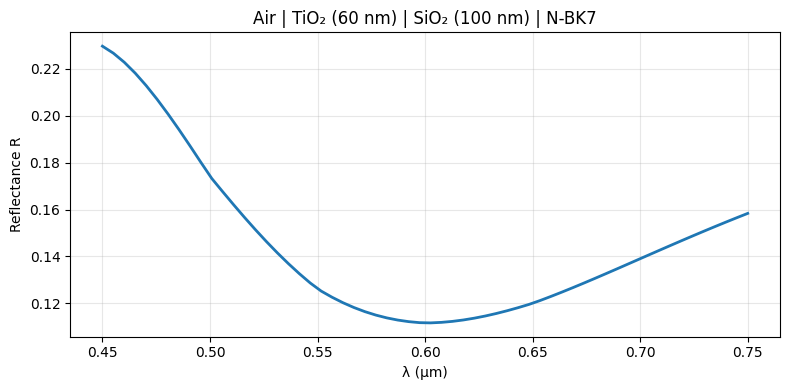
Pass material names straight into the solver — they're auto-wrapped in Material.
Here a two-layer TiO₂/SiO₂ AR coating on an N-BK7 substrate:
solver = IsotropicFilmSolver(
    mat_in="air",
    mat_out="N-BK7",
    mat_ls=["TiO2", "SiO2"],
    thickness_ls=[0.06, 0.10],     # 60 nm / 100 nm
    device=device,
)

wvln  = torch.linspace(0.45, 0.75, 60, device=device)
theta = torch.tensor([0.0], device=device)            # normal incidence
ts, tp, rs, rp = solver.simulate(theta=theta, wvln=wvln)

R = (rs.abs() ** 2).squeeze()      # broadband reflectance
Surface plasmon resonance
A metal layer in the Kretschmann configuration shows a sharp p-polarized reflection dip as surface plasmons are excited — driven by silver's large imaginary refractive index. Sweep the angle at 633 nm through a 50 nm silver film on a glass prism:
solver = IsotropicFilmSolver(
    mat_in=1.52,            # glass prism
    mat_out="air",
    mat_ls=["Ag"],
    thickness_ls=[0.05],     # 50 nm Ag
    device=device,
)

theta = torch.linspace(0.7, 1.2, 200, device=device)   # ~40-70 deg, radians
wvln  = torch.tensor([0.633], device=device)
_, _, _, rp = solver.simulate(theta=theta, wvln=wvln)

R_p = (rp.abs() ** 2).squeeze()    # reflection dip marks the plasmon resonance
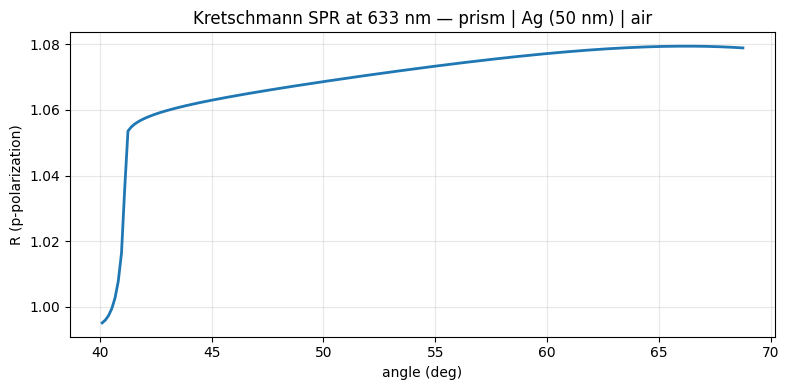
This SPR calculation is one of the cases DiffTMM is validated against the
reference NumPy TMM library. See 3_real_materials.ipynb for the full plots.